
Gladwin County Arrest Records and Court Charges
Arrest records and court charge records describe two different moments in a case. An arrest record documents the booking side, when a person is taken into custody by the sheriff or a police agency. The court charge record begins later, when the prosecutor files a charge and the court opens a case. In Gladwin County the sheriff runs the jail and booking, while the courts and prosecutor handle the charges.
The county does not publish a public mugshot gallery or a booking blotter, so this page does not promise one. For jail and booking detail, custody status runs through the sheriff and jail, and the Gladwin County inmate records page covers how to check that side. This page stays on the charges the court records.
Gladwin County Arrest Records Versus Court Charges
The clearest way to separate the two is to look at who keeps each file and what it holds. An arrest record sits with law enforcement and reflects the booking. A court charge record sits with the court and reflects the formal accusation and its progress.
| Point | Arrest Record | Court Charge Record |
|---|---|---|
| Kept by | Sheriff or police agency | District or circuit court |
| Marks | The booking into custody | The charge the prosecutor files |
| Starts | At arrest | When a complaint is filed |
| Where to look | Sheriff, or a records request | MiCOURT and the court file |
An arrest does not guarantee a charge. The prosecutor reviews the police report first and may decline to file, which means an arrest can exist without a court charge record ever opening. The reverse is also true, because a charge can be filed by summons without a person ever being booked into the jail.
Who Files Charges in Gladwin County
Charges are the prosecutor's decision, not the arresting officer's. The Gladwin County Prosecuting Attorney, Mark Toaz, authorizes and prosecutes violations of state law in the county and represents the People of the State of Michigan in district, circuit, and family court. After police investigate and submit a report, the prosecutor may file a criminal complaint, request more investigation, or decline to prosecute.
When charges are filed, they arrive through a charging document. Michigan uses three main types, and which one applies depends on the offense and the stage of the case.
| Charging Document | What It Is |
|---|---|
| Complaint | The written document that states the criminal charges and opens the case. |
| Information | The charging document that carries a felony forward to circuit court after bindover. |
| Indictment | A grand-jury charging document, used in jurisdictions and cases that rely on one. |
How Gladwin County Charge Status Changes
A charge is not fixed once it is filed. As a case develops, the prosecutor and the court can change what a defendant faces. Reading a charge record means watching for these status shifts, because the charge at filing may not be the charge at disposition.
| Charge Status | What It Means |
|---|---|
| Amended | The charge was changed to a different offense. |
| Reduced | The charge was lowered to a less serious offense. |
| Dropped | The prosecutor withdrew the charge. |
| Dismissed | The court closed the charge without a conviction. |
| Nolle prosequi | A formal decision by the prosecutor not to pursue the charge. |
Charge codes and severity levels also appear in the file. A code ties the charge to a specific statute, and the severity level flags whether it is a civil infraction, a misdemeanor, or a felony.
Charge Versus Conviction
The distinction that matters most is between a charge and a conviction. A charge is an accusation. A conviction is a finding of guilt by plea or verdict. A charge record can show serious offenses that never became convictions, which is why the outcome line is the one to read.
| Point | Charge | Conviction |
|---|---|---|
| Meaning | An accusation the prosecutor files | A finding of guilt |
| Certainty | Not proof of guilt | The court's final finding |
| Can change | Yes, before disposition | Stands unless set aside |
The full case file, including the plea, verdict, and sentence, lives in the Gladwin County criminal court records, which follow a charge through to its outcome.
Gladwin County Charge Records and Expungement
Once a case ends, a person may be able to set aside a conviction, which removes the charge record from public view. Michigan sets out who qualifies and what limits apply. Some offenses cannot be set aside at all, as the restrictions statute lists.
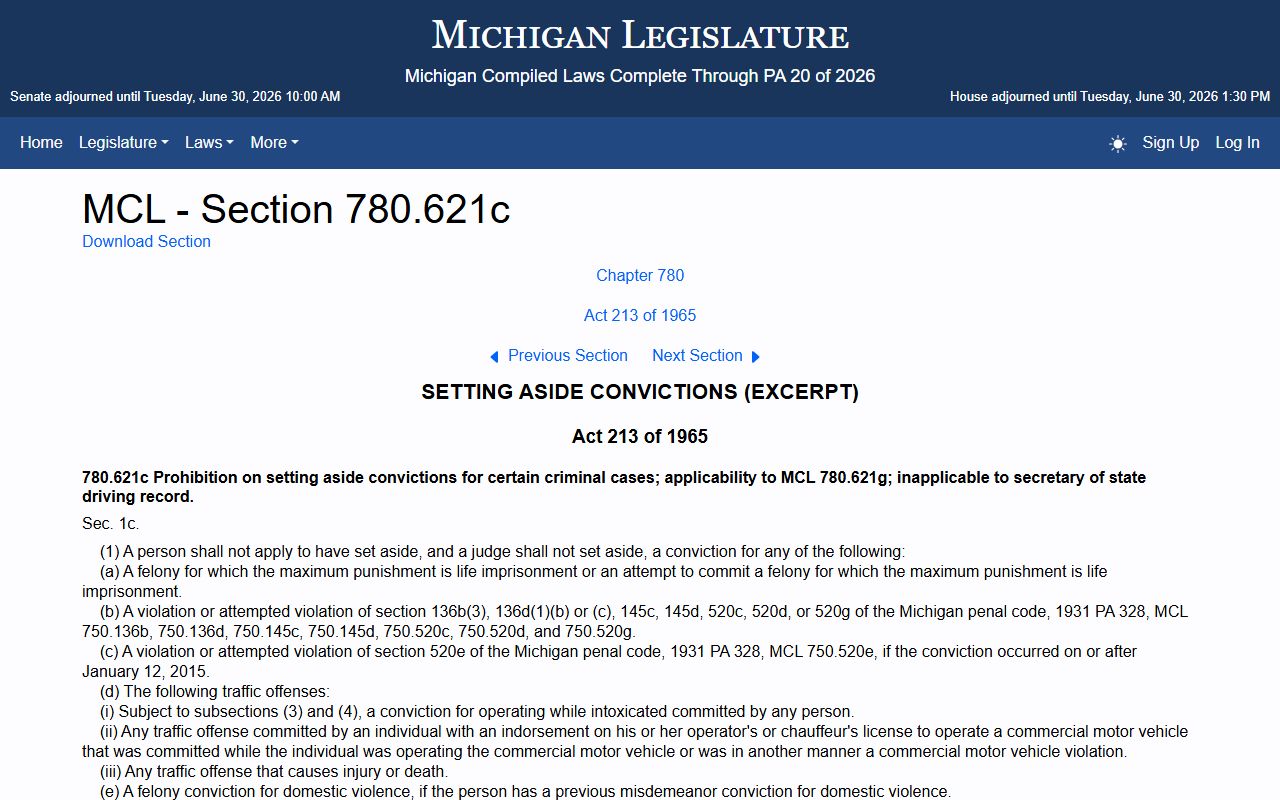
The limits on which convictions qualify are set by Michigan Compiled Laws § 780.621c.
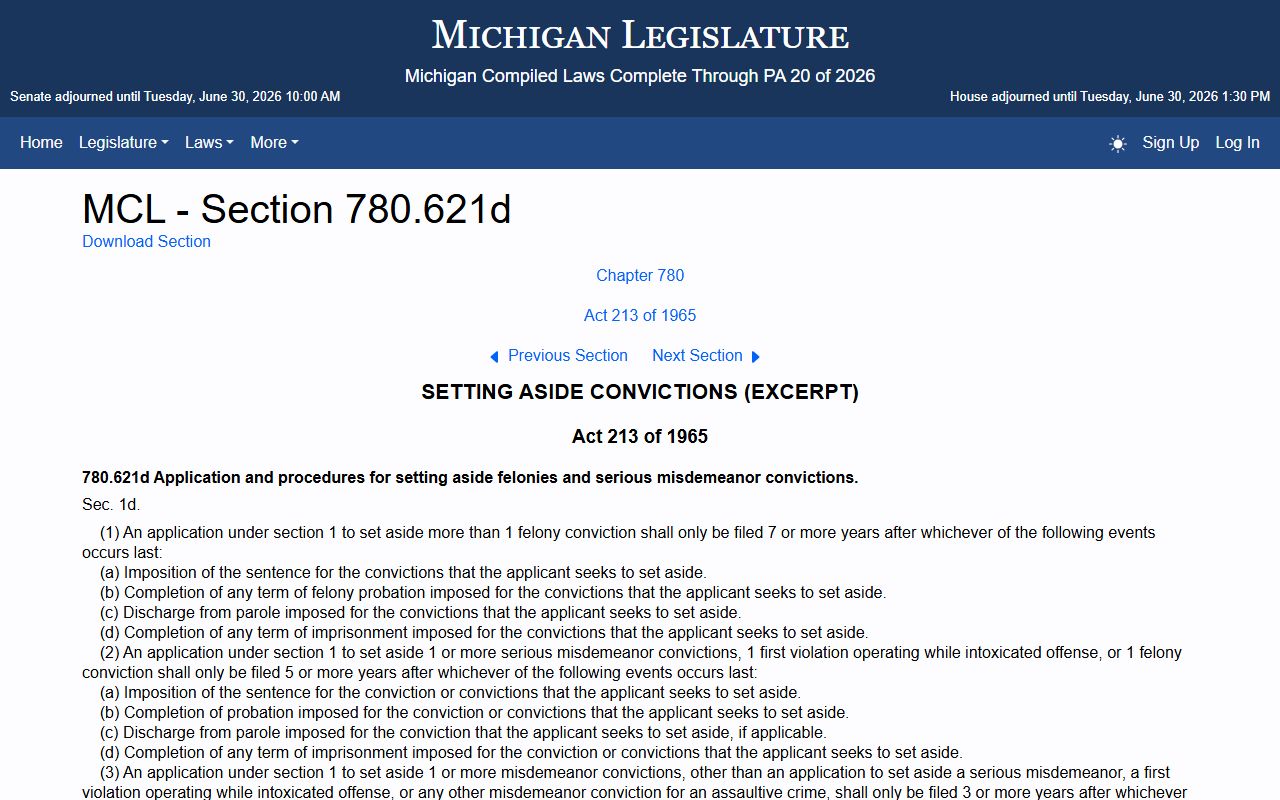
The rules for setting aside more than one offense sit in a separate section, which explains how multiple charges are treated together, as Michigan Compiled Laws § 780.621d provides.
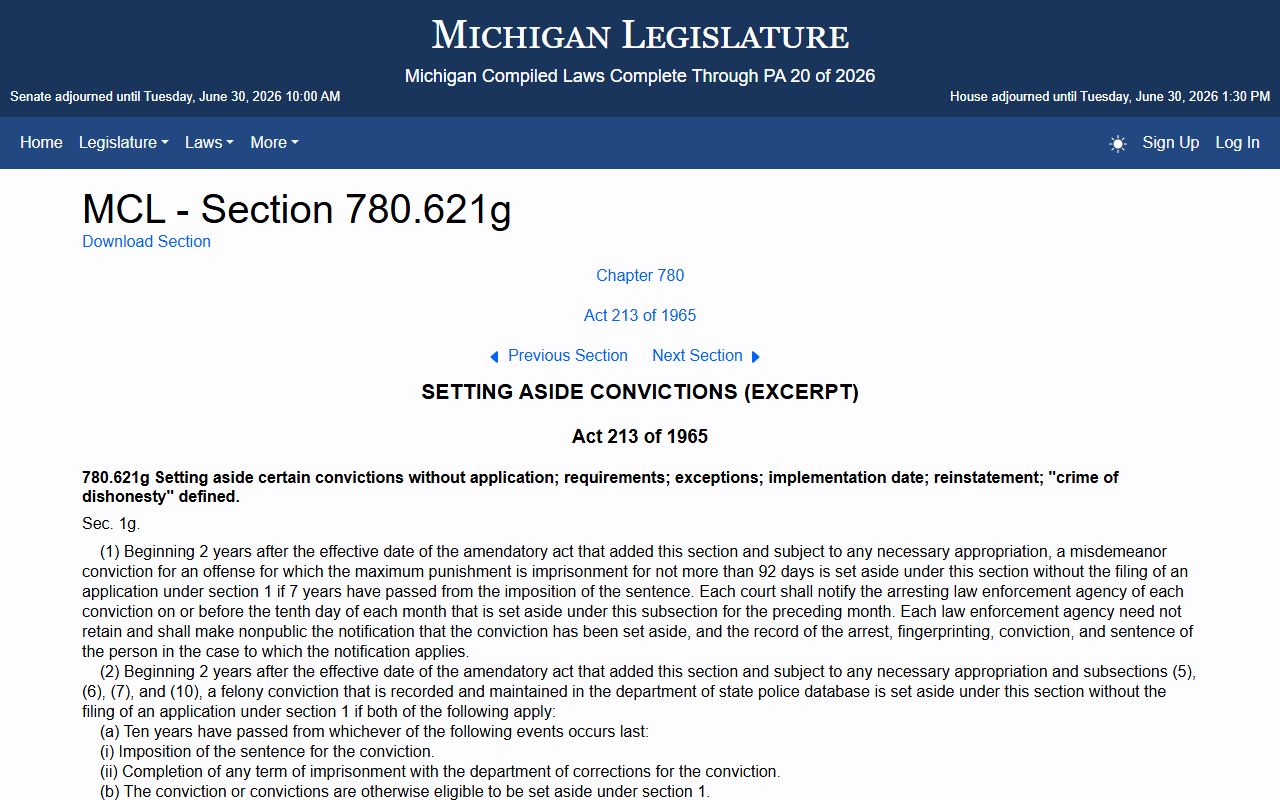
Michigan also sets certain convictions aside automatically under the Clean Slate framework, without an application, as Michigan Compiled Laws § 780.621g describes.
The County Clerk has processed hundreds of set-aside cases under this initiative, so an older charge may no longer appear in a routine search once a set-aside takes effect.
Gladwin County Charge Record Access Limits
Most charge records are public, but Michigan law shields certain material. The state Freedom of Information Act exempts some records from disclosure, including privacy-sensitive and law-enforcement material. That is why an arrest report and a court charge record can be treated differently when you request them.
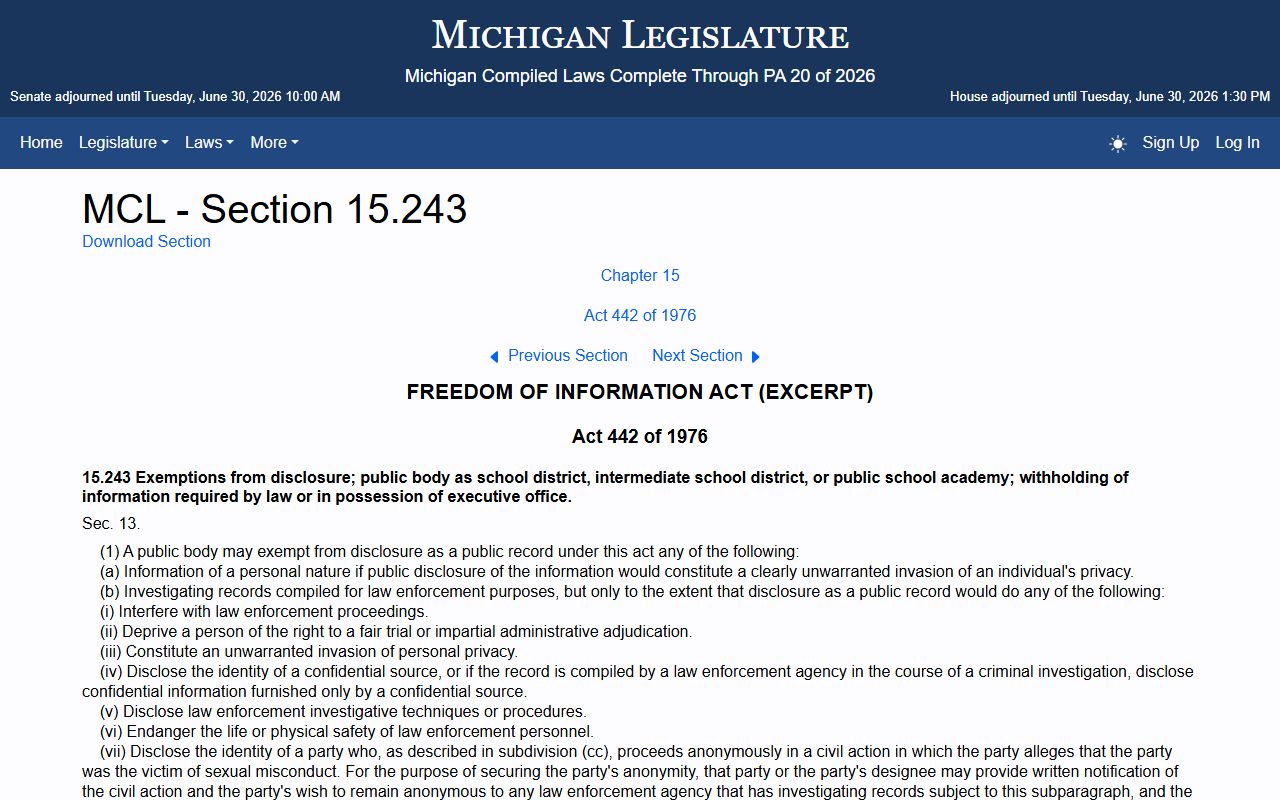
The exemptions that can keep some material out of public view are listed in Michigan Compiled Laws § 15.243.
Charge records also shift with the case. District court records become nonpublic right after a felony is bound over to circuit court for cases bound over on or after July 2, 2024, and juvenile charge records opened on or after January 1, 2021 are closed to the general public.
Bond and Release After Charges Are Filed
Once charges are filed, the court sets the terms of release. Bond is the money or the set of conditions a court uses to secure a defendant's appearance and protect the public. The bond entry in a charge record shows what the court required and whether the defendant is in custody or released while the case is pending.
The booking side of custody runs through the Gladwin County Jail, which holds up to 72 adult offenders and includes people awaiting pretrial hearings. The county does not post a public roster, so custody status is confirmed through the jail. When a defendant is in jail, a victim can ask the sheriff's department to provide notification of release by calling jail administration at 989.426.7121.
Note: A bond amount in a charge record is a release condition, not a fine, so it does not tell you how the case will end.
Gladwin County Charge Records Versus the Full Case File
A charge record is one slice of a criminal matter. It tracks what the prosecutor filed and how the charge changed, but it is not the complete court file. The full file adds the arraignment, motions, hearings, plea or verdict, disposition, and sentence.
That is why a charge lookup and a full-record request are different tasks. To see how a charge was resolved, you follow the case to its outcome rather than stopping at the charge itself. The distinction keeps a reader from assuming a filed charge is the last word, when the case may have moved well past it.
Facing Charges and the Federal Boundary
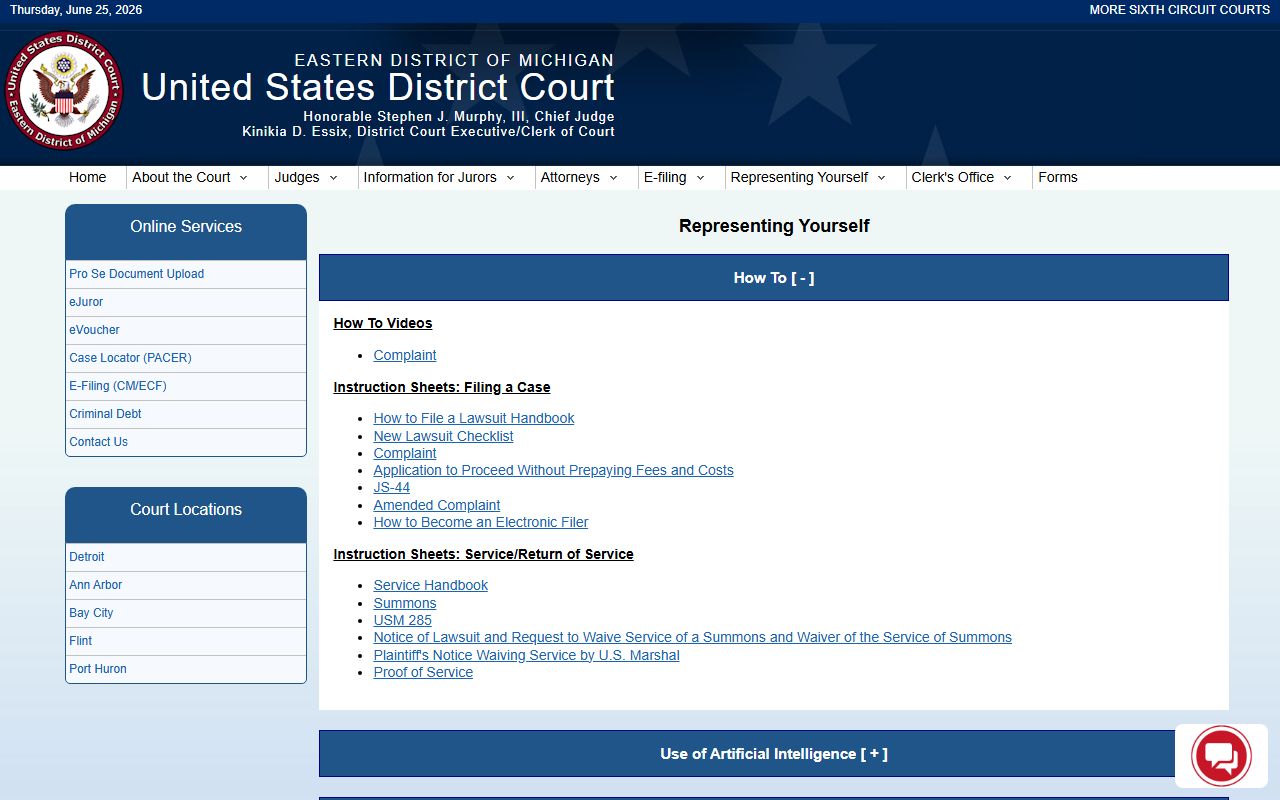
A person named in a charge record has the right to counsel and, in some settings, to represent themselves. Federal courts publish guidance on self-representation for defendants who appear without a lawyer, which is a useful reference point even though most Gladwin County charges are state matters.
The federal court for this region explains the process for appearing without an attorney, as the Eastern District of Michigan self-representation page shows.
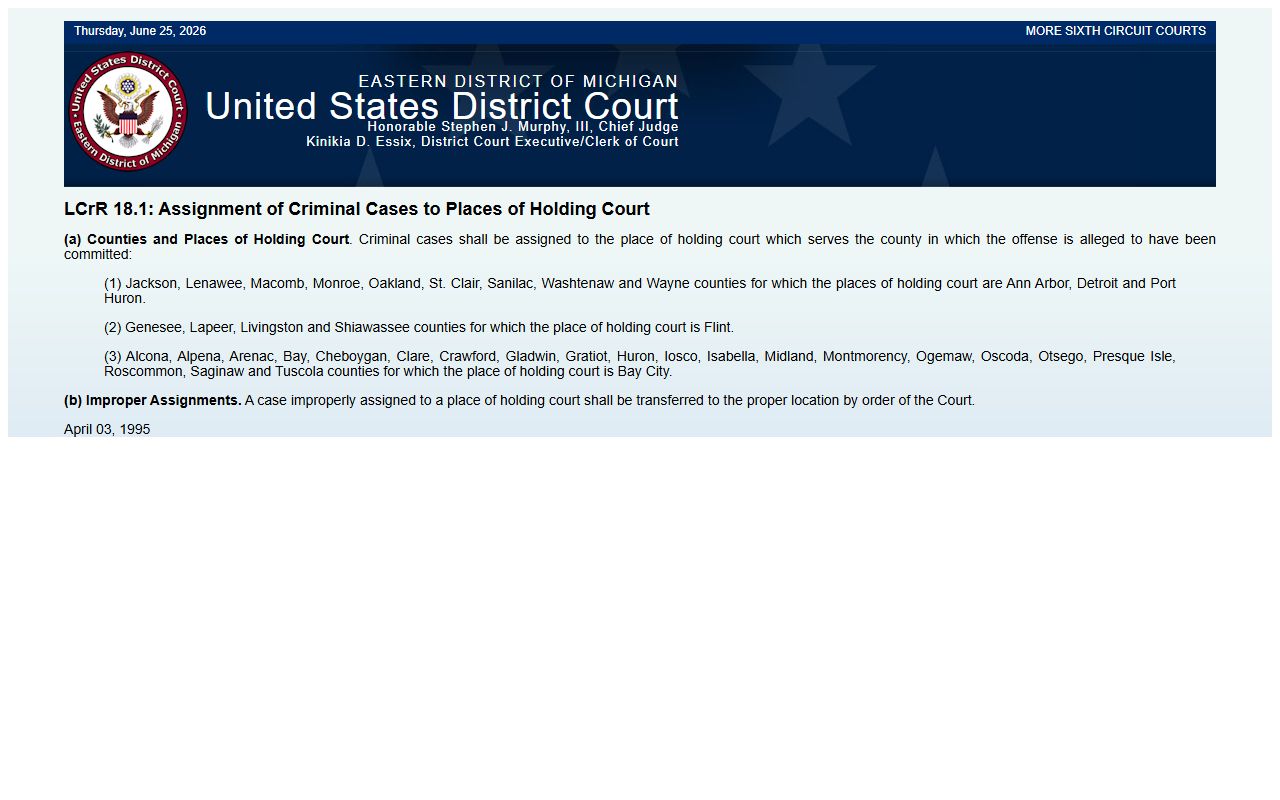
Federal charges are not county court records. They follow their own assignment rules and are filed in the federal system rather than the county courts, as the Eastern District criminal assignment rule sets out.
For a county charge, the district court and the County Clerk are the offices that hold the file, not the federal court.
Most people looking up charges are tracking a state case that began with a local arrest. That path runs through the district court first, then the circuit court for a felony after bindover. The federal references matter only when a matter is genuinely federal, which is rare for the everyday charge record a county resident wants to check.