
Gladwin County District Court Overview
Michigan has 103 district courts, and each one is a court of limited jurisdiction. The district court handles the lower-dollar and lower-level cases that make up most day-to-day court traffic. In Gladwin County that court is the 80th District Court, sitting inside the Cedar Avenue courthouse and sharing the campus with the circuit and probate courts.
The district court is the initial court for all criminal matters, all traffic, and DNR and animal control tickets, including City of Beaverton and City of Gladwin cases. It hears civil infractions, misdemeanors, and the first stage of felonies. The county's own court page lays out its jurisdiction, payment options, and office extensions.
The court's civil reach covers suits up to $25,000, small claims up to $6,500, and landlord-tenant summary proceedings. On the criminal side it handles misdemeanors, ordinance violations, and the preliminary exams that decide whether a felony moves up to circuit court. Because it is the first court most residents meet, the district court also holds jury trials in the cases within its limits.
The county publishes the court's contact and service detail on its official district court page. You can review the full jurisdiction summary on the Gladwin County 80th District Court page before you call or visit.
That page confirms the extensions used to route calls by subject, which is the fastest way to reach the right clerk for a district case.
Gladwin County District Court Service Lines
The 80th District Court routes calls by subject rather than by a single front desk. Each extension reaches the staff who handle that kind of case. One quirk to remember is that the district court phone system does not accept voicemail, so calls need to reach a person during office hours, which run weekdays from 8:30 a.m. to 4:30 p.m. Reaching the correct extension the first time is the fastest way to get an answer, since a misrouted call cannot be left as a message.
| Matter | Extension | What It Covers |
|---|---|---|
| Criminal | Ext. 4 | Misdemeanors and felony first appearances. |
| Civil | Ext. 5 | Civil suits up to $25,000. |
| Traffic, DNR, animal control, jurors | Ext. 6 | Citations, infractions, and juror questions. |
| Small claims, landlord-tenant, drunk driving | Ext. 7 | Summary proceedings and OWI matters. |
District Court vs. Circuit Court vs. Probate Court
Gladwin County splits its trial work across three courts. The district court carries the everyday volume, the circuit court takes the heavier cases, and the probate court handles estates and protective matters. The table shows where a case belongs by size and subject.
Knowing the split saves a wasted trip. A speeding ticket, a $3,000 contract dispute, or an eviction belongs in the district court. A felony trial, a divorce, or a civil suit over $25,000 belongs in the circuit court. An estate or a guardianship belongs in the probate court. When a case is filed in the wrong court, it has to be moved, which costs time that the right filing avoids from the start.
| District Court | Circuit Court | Probate Court | |
|---|---|---|---|
| Civil Limit | Up to $25,000 | Over $25,000 | Estate value based |
| Criminal | Misdemeanors, prelim exams | Felonies | None |
| Small Claims | Up to $6,500 | No | No |
| Family or Probate | None | Divorce, custody, juvenile | Guardianship, estates |
How a Gladwin County District Case Moves
Most cases open in the district court. Traffic and misdemeanor matters usually finish there, while felonies pass through an early stage before moving up. The arrows below show both a common criminal track and a civil track.
The felony route is the reason the district court matters even in the most serious cases. A felony begins with an arraignment and a preliminary exam in district court, where a judge decides whether there is enough evidence to send the case up. Once the case is bound over, the file moves to the circuit court and the lower court record can become nonpublic. That handoff is worth remembering when a felony file seems to vanish from the district court.
Criminal flow: Citation or Arrest › District Arraignment › Pretrial › Plea or Trial › Sentencing, or Preliminary Exam › Bindover to Circuit for felonies
Civil flow: Complaint Filed › Summons and Service › Answer › Hearing › Judgment › Collection
Criminal, Civil, and Traffic Work
The district court's docket falls into a few large buckets. Criminal work covers misdemeanors and the first stage of felonies. Civil work covers money disputes up to the district limit, plus small claims and landlord-tenant summary proceedings. Traffic work is the largest single share and runs through the court's citation process.
Small claims cases in Michigan reach up to $6,500 and are meant for people who bring their own dispute without a lawyer. Landlord-tenant matters move on a faster summary track. Detailed traffic penalties, points, and payment steps sit on the Gladwin County traffic court records page, which draws from the same district court.
The county publishes a set of resources that help a party prepare before a hearing. These cover the everyday questions about fees, forms, and how to reach the court for a specific kind of case.
- Schedule of fines and points for traffic and civil infraction cases.
- Court forms and small-claims information for self-represented parties.
- Language access services for people who need an interpreter.
- Local administrative orders that set court procedure.
- Civil filing fee schedule for district and small-claims cases.
Paying District Court Fines and Fees
The district court accepts payments by phone and online as well as in person. Payments can be made by phone at 888.604.7888 or online through GovPayNOW, using the court's payment location code 5073. Major cards are accepted, and a service fee applies to card transactions. The county also publishes a civil filing fee schedule for the district and small claims cases.
Fines and points vary by offense, and a paid ticket is treated as an admission of responsibility that can add points to a driving record. A driver who wants to contest a ticket can ask for a hearing instead of paying. The court's schedule of fines and points is the starting point for understanding what a given citation costs before any hearing.
Note: The GovPayNOW code for district court is 5073, which is different from the sheriff's civil process payment code, so confirm the code before you pay.
Filing and E-Filing in the District Court
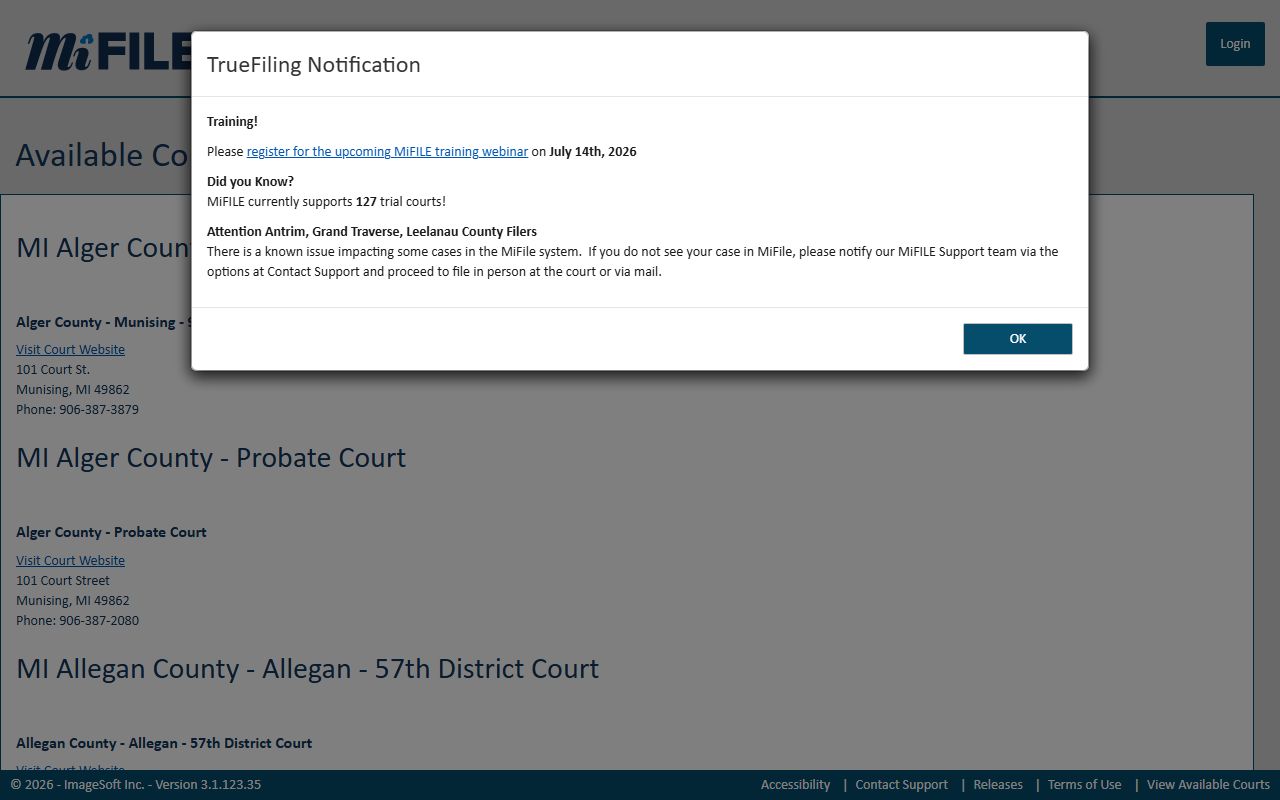
Michigan runs a statewide electronic filing system called MiFILE. The available-courts list confirms that the Gladwin 80-2 District Court is part of the network, so many documents can be filed online rather than at the counter. Paper filing and counter service remain available during weekday courthouse hours, which gives filers a choice between an online submission and an in-person visit depending on the case.
The state maintains the current list of courts wired into the system. You can confirm the district court's status on the MiFILE available courts directory before you register.
Once a case is filed, questions about circuit papers, circuit payments, and general case lookup go to the county clerk, because the clerk is the circuit court clerk. Certified copies of district files are requested through the same courthouse offices.
Do all traffic tickets go to the district court? Yes. The 80th District Court is the initial court for every traffic citation in the county, along with DNR and animal control tickets and city ordinance matters. Only a drunk-driving charge shifts toward the criminal side, and it still starts in the same district court on extension 7. Every other citation, from speeding to a city ordinance ticket, opens here as well.
Can I file without coming to the courthouse? Often, yes. Many documents can be filed online through MiFILE, and fines can be paid by phone or through GovPayNOW. Counter service remains open on weekdays for filings and questions that need a person, since the court phone line does not take voicemail.