
What Gladwin County Criminal Court Records Are
A criminal court record is the file the court clerk opens and keeps once a criminal case begins. It is more than a list of charges. It captures every event in the matter, the documents each side files, the rulings the judge makes, and the outcome. In Gladwin County, that file is produced by the court that handles the case at each stage.
The 80th District Court is the initial court for all criminal matters, including misdemeanors and the early stages of felonies. Felonies then move to the 55th Circuit Court after arraignment and a preliminary exam. The prosecutor, Mark Toaz, represents the People of the State of Michigan in these cases and decides what to charge. For the charges themselves and how they change, the Gladwin County arrest records and charges page goes deeper, while this page follows the full case file and its outcome.
How a Criminal Case Moves Through Gladwin County
A criminal case follows a predictable path, and the record grows at each step. The county prosecutor's office lays out this workflow from the first report through the court process. Knowing the sequence helps you read a file, because each stage leaves its own entries in the record.
Case flow: Charges Filed › Arraignment › Pretrial › Plea or Trial › Disposition › Sentencing
The county page walks through each of these steps, as the prosecutor's steps in a criminal case guide shows.
A crime is reported, police investigate and write a report, and that report goes to the prosecutor. The prosecutor may file a complaint, ask for more investigation, or decline to prosecute. Once a complaint is filed, the case proceeds as a misdemeanor or felony through the court steps above. Each of those steps leaves a dated entry in the record, so the file reads as a timeline from the first appearance to the final order.
What a Gladwin County Criminal Court Record Shows
A criminal file is organized around fields that repeat from case to case. County request forms and Michigan court rules confirm the core set. The table below lists what a reader will typically find in a Gladwin County criminal court record.
| Field | What It Shows |
|---|---|
| Case Number | The unique identifier assigned when the case opened. |
| Defendant | The person charged with the crime. |
| Charges | The offenses and the statutes the prosecutor filed. |
| Arraignment | The first court appearance and the plea entered. |
| Hearings and Motions | Pretrial dates, motions, and the assigned judge. |
| Disposition | How the case ended, such as a plea, verdict, or dismissal. |
| Sentence | Any jail time, probation, fines, or restitution ordered. |
Reading Gladwin County Criminal Records
Criminal files use terms that carry precise meanings, and the county keeps a plain-language definitions page for exactly this reason. A complaint is the written document stating the charges. A defendant is the person charged. A bench trial is a trial before a judge without a jury. Bond is the money or conditions set to secure appearance and protect the public.
These definitions come straight from the county, as the prosecutor's criminal definitions page confirms.
The disposition line is the one most people look for. It tells you whether the case ended in a plea, a trial verdict, a dismissal, or a bindover to circuit court. The sentence, if any, follows the disposition and lists the penalties the court imposed.
Charges Versus Convictions
The most common misreading of a criminal file is treating a charge as if it were a conviction. They are not the same. A charge is an accusation the prosecutor files. A conviction is what a plea or a verdict establishes. A file can list serious charges that were later reduced, dismissed, or resolved without a conviction at all.
| Point | Charge | Conviction |
|---|---|---|
| What it is | An accusation the prosecutor files | A finding of guilt by plea or verdict |
| When it appears | At the start of the case | At disposition, if guilt is established |
| Can it change | Yes, it may be amended, reduced, or dropped | It stands unless set aside by law |
| Legal weight | Not proof of guilt | The court's final finding |
Read the disposition and sentence before you conclude anything from the charges alone.
Expungement and the Clean Slate Initiative
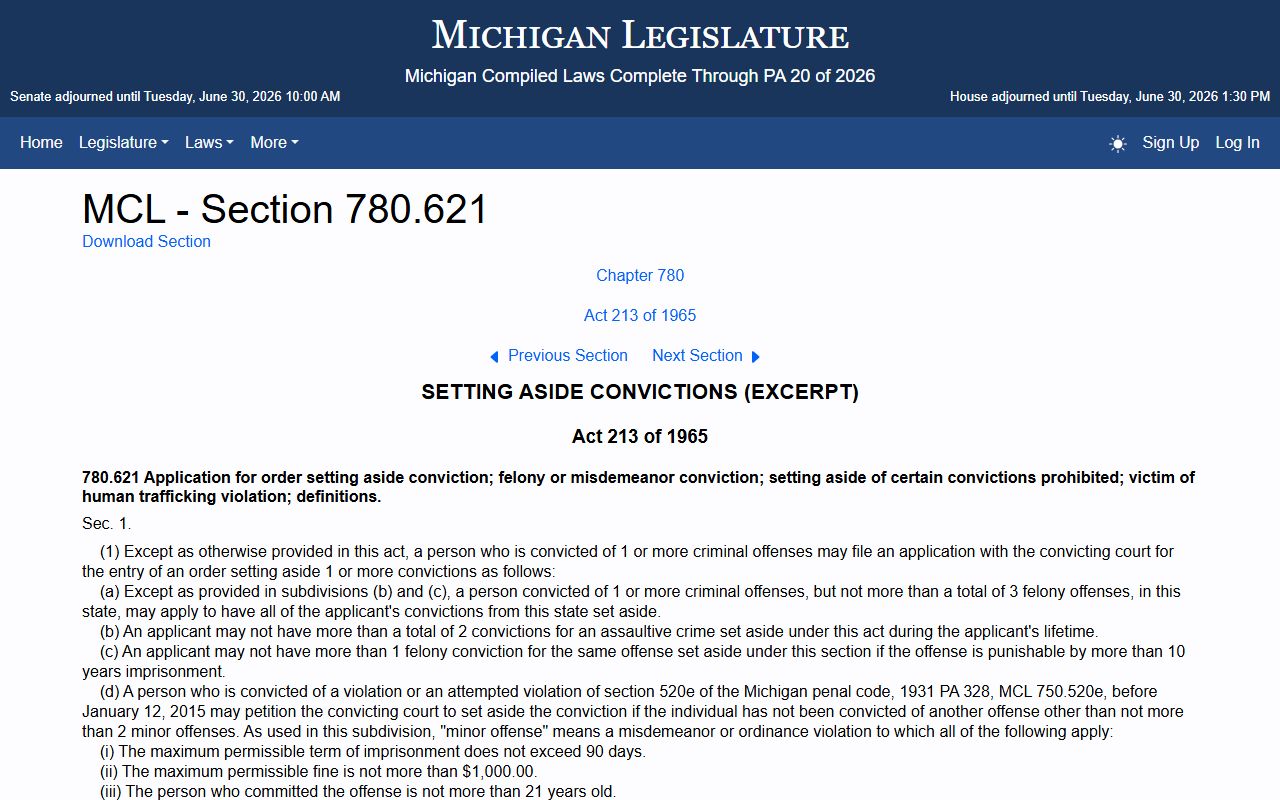
Michigan lets people ask a court to set aside certain convictions, which removes them from public view. The application process is set by statute, and the County Clerk has been active in this work, processing 421 set-aside cases from April to December of one recent year in connection with the state Clean Slate Initiative.
The application rules live in state law, as Michigan Compiled Laws § 780.621 sets out.
An expungement does not erase the fact that a case happened for every purpose, but it does make the set-aside conviction nonpublic. That is why an older record may no longer appear in a routine search once a set-aside is granted.
Restricted Gladwin County Criminal Records
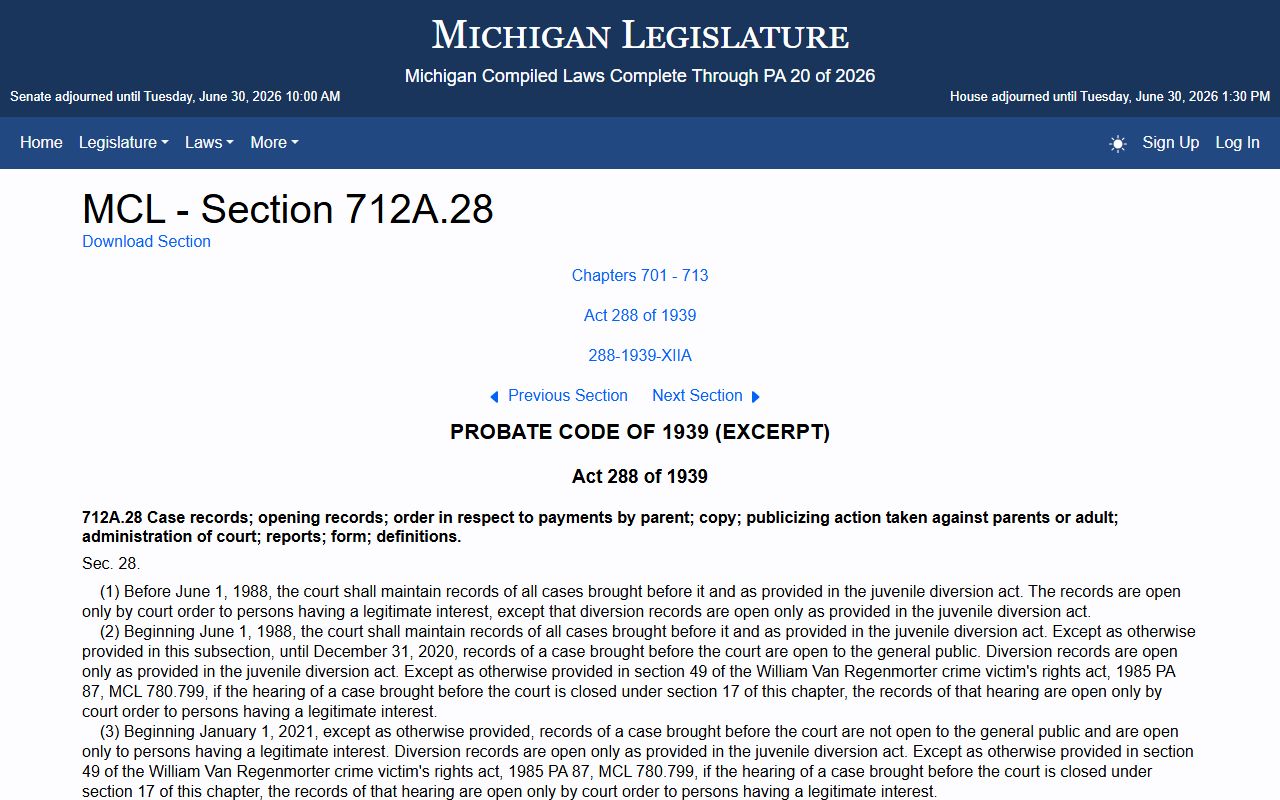
Juvenile criminal records carry the firmest limits. Under Michigan law, juvenile case records opened on or after January 1, 2021 are not open to the general public, and access is limited to people with a legitimate interest, such as the juvenile, a parent, counsel, and named agencies. Juvenile petitions in Gladwin County start in the family division of the circuit court.
The juvenile-records rule is written into statute, as Michigan Compiled Laws § 712A.28 provides.
Adult files can be restricted too. District or municipal court records become nonpublic right after a felony is bound over to circuit court for cases bound over on or after July 2, 2024, and personal identifiers stay protected in every file.
Sealed Versus Expunged Records
Sealing and expungement both limit access, but they work differently. Sealing makes a file nonpublic while the case itself still exists on the court's books. Expungement, or setting aside, removes a qualifying conviction from public view under the state statute. The comparison below draws the line.
| Point | Sealed | Expunged |
|---|---|---|
| What happens | The file is made nonpublic by court order | A conviction is set aside under statute |
| Legal basis | Court rule and a showing of good cause | The state set-aside law |
| Who can view it | Parties and those the order allows | Limited access after the set-aside |
| Applies to | Documents in a case | Eligible convictions |
Note: A court cannot seal its own orders or opinions, so some parts of a case may stay visible even when other documents are sealed.
Gladwin County District and Circuit Criminal Files
Two courts produce most criminal records in the county, and each holds a different stage. The 80th District Court records misdemeanors, traffic-related criminal matters, and the early steps of every felony, including arraignment and the preliminary exam. The 55th Circuit Court records felonies after bindover, carrying the case through trial or plea and into sentencing.
The district court routes questions by subject, with criminal matters on extension 4. Circuit questions, including case lookup and payments, go to the County Clerk because the clerk serves as the circuit court clerk. Knowing which court held a case at each stage tells you which office to ask for the file.
- Misdemeanors and traffic-criminal matters stay in the district court.
- Felony arraignments and preliminary exams begin in the district court.
- Felonies after bindover, plus sentencing, sit in the circuit court.
Requesting Gladwin County Criminal Court Records
Where you request a criminal file depends on the court that holds it. Circuit court copies run through the County Clerk request form, which needs the case number, party names, the documents you want, and a copy of your photo ID. Restricted files require party status or authorization. District court criminal matters are handled by the district court office on its criminal extension.
For the full walkthrough of clerk copies and access rules that apply to every case type, the Gladwin County court records page covers the request process in detail.
Before you request, decide whether you need a certified copy or a plain one. A certified circuit document costs $10 and true copies run $1 per page, while a certified copy is the version courts and agencies accept for official use. Bring the case number and party names, since court staff cannot search on vague details or give legal advice about a file.
Note: A charge listed in an open file is not a conviction, so confirm the disposition and sentence before you treat any criminal record as final.